In recent months, the Ministry of Commerce and Industry sent a notice to every registered company in Kuwait. Many read it and moved on. Those who read it carefully realized they have less than a year to fundamentally change how they file their annual financial statements — permanently.
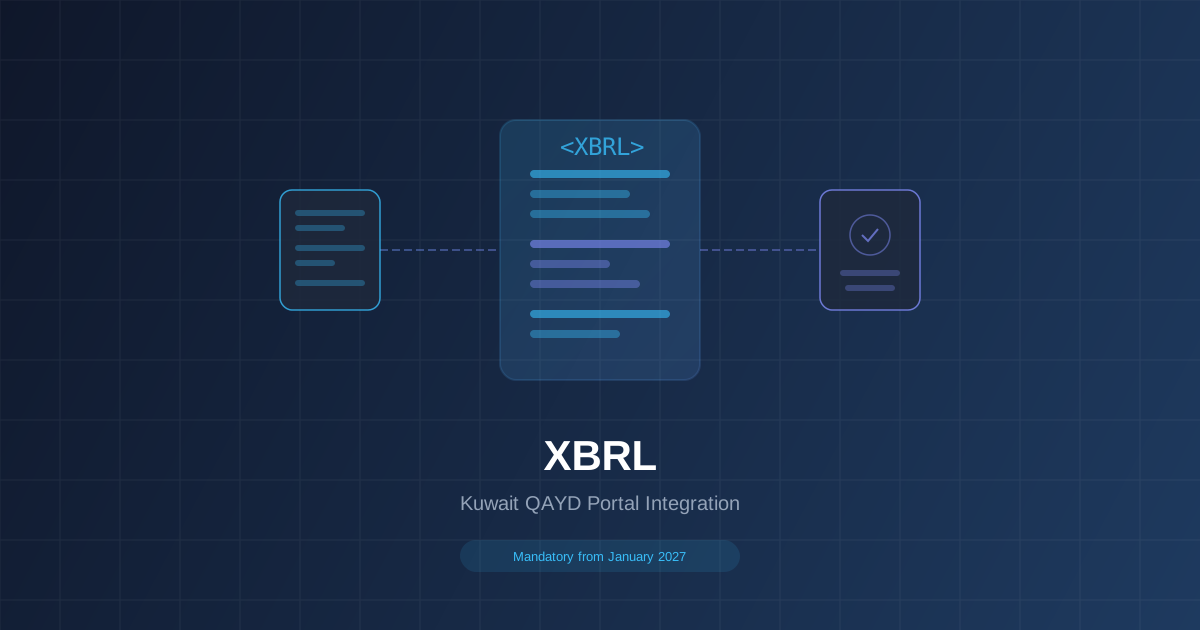
The decision is clear: starting January 1, 2027, the Ministry will no longer accept financial statements the old way. No paper. No PDF files. The only path is the XBRL system through the "QAYD" electronic portal.
This article isn't a sales pitch. Its goal is to help you understand — before anything else — what XBRL is, why Kuwait adopted it, and what you actually need to do to prepare. If you walk away with a clear picture of where you stand, it's done its job.
What Is XBRL? And Why Does It Change Everything?
XBRL (eXtensible Business Reporting Language) is an open international standard for converting financial statements from text documents — like PDF or Word files — into structured, machine-readable digital data.
The Simple Difference: PDF vs. XBRL
Imagine you're submitting your balance sheet to the Ministry today:
The Current Way (PDF):
- You send a PDF file — a document read by human eyes
- A ministry employee opens the file, reads the numbers, and manually enters them into the system
- There's no automated way to verify accuracy or compare across companies
- Human errors are possible at every step
The New Way (XBRL):
- You send an XBRL file — every number in it is identified with a clear tag
- For example: instead of writing "Total Assets: 500,000 KWD" in a line inside a PDF, the number is tagged like this:
<Total_Assets>500000</Total_Assets> - The system reads data automatically, validates consistency, and immediately rejects the file if something is wrong
- Data from thousands of companies can be compared in seconds
Why Does This Matter?
XBRL isn't a Kuwaiti invention — it's a standard used by over 60 countries worldwide, including the United States (SEC), the European Union, Japan, India, and Saudi Arabia. Kuwait is now joining this ecosystem to achieve:
- Greater financial transparency: The Ministry can instantly detect inconsistencies in financial statements
- Faster processing: Instead of weeks of manual review, validation happens in minutes
- Better economic decisions: Structured data enables precise analysis of economic sector performance
- Anti-fraud measures: It's much harder to submit contradictory figures when a computer checks them automatically
The QAYD Portal — Kuwait's New National System
The Ministry of Commerce and Industry launched the "QAYD" project through the official portal qayd.moci.gov.kw — the only approved electronic platform for filing financial statements in XBRL format.
The Official Timeline
| Phase | Status | Details |
|---|---|---|
| January – December 2026 | Voluntary | Companies can continue with current methods or optionally try the QAYD portal |
| January 1, 2027 | Mandatory | XBRL is mandatory for all companies — paper submissions permanently discontinued |
Legal Consequence: The Ministry has confirmed that non-compliance after January 1, 2027 will result in legal action under Companies Law No. 1 of 2016 and its executive regulations, up to and including revocation of the commercial license.
Who Does This Apply To?
Companies
All legal entities registered in Kuwait, without exception:
- Limited liability companies
- Public and closed joint-stock companies
- General partnerships and limited partnerships
- Sole proprietorships
Even companies that were not previously required to submit financial statements — such as limited partnerships and sole proprietorships — are now covered by this decision.
All entities must file their financial statements through the QAYD portal within six months of their fiscal year-end.
Audit and Review Firms
The Ministry has explicitly confirmed that audit firms are required to use the XBRL system when preparing and certifying balance sheets and financial statements for their clients starting in 2027, and to participate in Ministry-approved training programs.
The Real Challenge: Why Your Accounting System Alone Isn't Enough
Here's the point many overlook: having an accounting system — no matter how advanced — doesn't mean you're ready for the QAYD portal.
The problem isn't the accuracy of your numbers. The problem is the format of their submission. Your system produces excellent financial reports for human reading, but the QAYD portal expects a structured XBRL file with specific standards:
- Approved taxonomy: Every financial line item must match a specific classification approved by the Ministry — not just an account name in your chart of accounts
- Specific XBRL file structure: A precise technical format that's different from any PDF or Excel report you currently produce
- Automated validation: The portal runs dozens of automatic checks before accepting a file — any structural error means immediate rejection
- Sadad payment: Completed after the filing is submitted and accepted
Practical note: Most integration projects require 60 to 90 days. The later you start, the narrower your window for testing and corrections before the mandatory deadline.
Want to know how ready your current system is? We offer a free assessment where we review your technical setup and identify gaps — with no obligation. Book a free assessment →
Practical Preparation Steps
If you're using Odoo or considering switching to it, these are the essential steps you need:
1. Technical Gap Assessment
Start by reviewing your current system: Does it support XBRL export? Does your chart of accounts align with the ministry-approved taxonomies? How extensive are the required modifications?
2. Install an XBRL Module in Odoo
Odoo's modular architecture makes it ideal for this. The best approach is a custom module built directly inside Odoo that exports your financial data in XBRL format compatible with the QAYD portal — no external tools or manual data transfers needed.
3. Chart of Accounts Mapping
Review your account structure and adjust any conflicts with the approved taxonomies in the QAYD data schema — this step determines whether your files will be accepted on the first upload.
4. Portal Testing
Take advantage of the voluntary 2026 period to conduct actual tests on the QAYD portal. Upload real data and make sure you receive an acceptance notification.
5. Finance Team Training
Your finance team is who will manage the annual filing cycle. Make sure they understand the process and can execute it independently.
Why Odoo Is the Best System for QAYD Compliance
Odoo stands out as the ideal system for integrating with the QAYD portal:
- Flexible module architecture: A custom XBRL module can be built directly inside Odoo — no external tools or integration layers needed
- Customizable chart of accounts: Easy to map your account structure to the ministry-approved taxonomies
- Automated export: Once the module is installed, your finance team can generate an XBRL file with one click from within Odoo
- Lower cost: Direct integration inside the system is more cost-effective than building external connectors
- Continuous updates: Any future changes to the QAYD data schema are updated directly in the module
| Scenario | Situation | What We Provide |
|---|---|---|
| Company already on Odoo | System ready but needs XBRL module | Custom module development and direct QAYD integration |
| Company wanting to switch to Odoo | Wants a modern system ready for QAYD from day one | Full Odoo implementation with built-in XBRL module |
| Audit and review firm | Serves dozens of companies on Odoo | Centralized solution managing multiple filings from one platform |
Frequently Asked Questions
Does this decision apply to my company even if I've never submitted a balance sheet before? Yes. According to the Ministry's announcement, the decision covers all registered legal entities without exception. The project specifically targets requiring companies that were not previously obligated to disclose — such as limited partnerships and sole proprietorships — to begin submitting their financial statements.
What's the actual difference between 2026 and 2027? In 2026, you can continue with the current process and optionally try QAYD with no legal obligation. In 2027, paper submissions are permanently discontinued, XBRL becomes the only path, and there are explicit legal consequences for non-compliance.
Is the audit firm serving our company responsible for the conversion? Partially. Audit firms are required to use the system when preparing and certifying financial statements. However, technical readiness on the company's side — accurate data and a compatible chart of accounts — is a shared responsibility.
How long does implementation take? It ranges from 60 to 90 days depending on the complexity of the current system and company size. The ideal time to start is now — because the voluntary 2026 period gives you a safe margin for testing and corrections.
We don't use Odoo yet — can we switch? Absolutely. Many of our clients have switched to Odoo specifically for its flexibility and customizability. We handle the full migration and ensure your system is QAYD-ready from day one.
Need Help Preparing?
At Kuwait Coders, we are the official Odoo partner in Kuwait since 2019. We develop a custom XBRL module that works directly inside Odoo and integrates with the QAYD portal.
Why us?
- Local expertise: Our team works inside Kuwait and understands the Ministry of Commerce requirements — support in Arabic, in person
- Custom development: We build the solution that fits your company's actual data — we don't resell standard tools
- Transparent pricing: A fixed price in Kuwaiti Dinars agreed upon in advance — no open-ended hours, no surprise invoices
- Delivery in 90 days: A defined timeline with clear milestones and deliverables
- Experience since 2012: Over 14 years of software development and technical integrations, and an official Odoo partner since 2019
Start with a Free Assessment
The first step costs you nothing. A 30-minute assessment session where we review your current technical situation and identify gaps — so you can make your decision with complete information.
Contact Us:
- Phone: +965 50607808
- Email: info@q8coders.com
- Website: q8coders.com
Book Your Free Assessment Session →
No prior commitment required · Response within one business day · Service available in Arabic
Abdulaziz AlOtaibi — Founder of Kuwait Coders, Official Odoo Partner in Kuwait since 2019 For official information about the QAYD system: qayd.moci.gov.kw