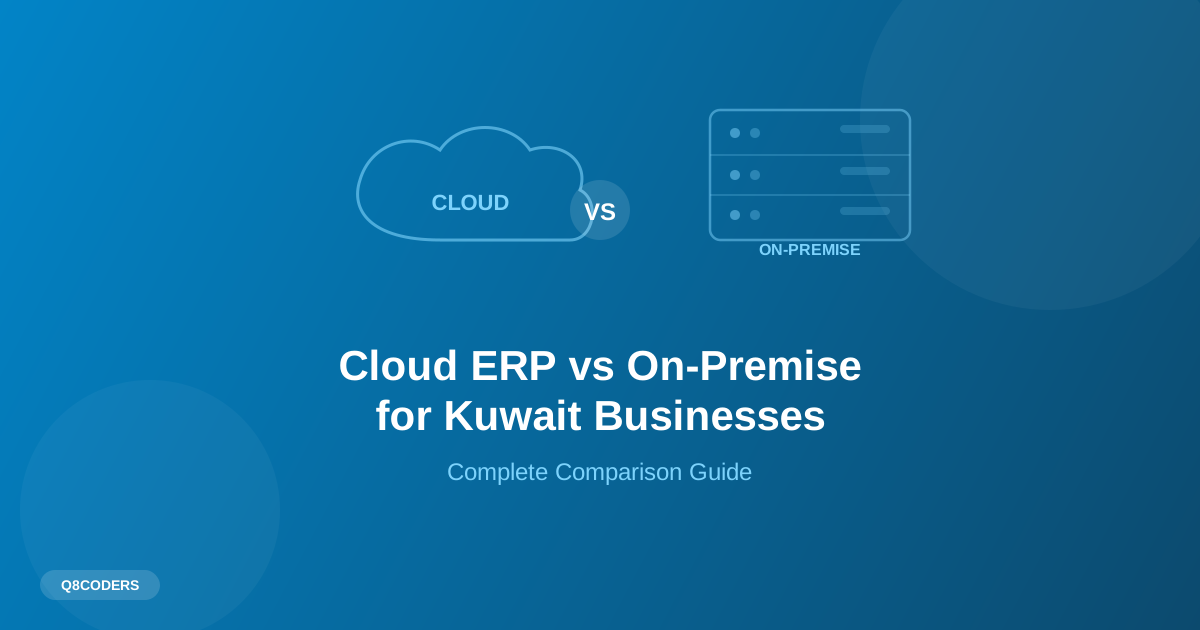
The decision between cloud and on-premise ERP deployment is one of the most important infrastructure choices a Kuwait business will make. It affects your costs, security posture, data control, scalability, and day-to-day operations for years to come. There is no universally correct answer — the right choice depends on your specific business requirements, regulatory environment, and growth plans.
This guide provides an honest, side-by-side comparison to help you make an informed decision.
Understanding the Options
Cloud ERP
Your ERP system runs on servers managed by a cloud provider (such as AWS, Azure, or Odoo's own cloud). You access it through a web browser. The provider handles server maintenance, security patches, backups, and uptime.
On-Premise ERP
The ERP system runs on physical servers that you own and maintain in your own facility or a local data center in Kuwait. Your IT team (or a managed service provider) is responsible for hardware, networking, security, and backups.
Hybrid
A combination where some ERP components run in the cloud and others on-premise. For example, your main ERP database stays on-premise for regulatory compliance, while customer-facing applications run in the cloud for better performance and availability.
Cost Comparison
Cost is often the first factor businesses consider, but the comparison is not as straightforward as monthly fees vs. upfront investment.
Cloud ERP Costs
- Subscription fees: Monthly or annual per-user fees (typically 10-50 KWD per user per month depending on the platform and modules)
- No upfront hardware: Zero investment in servers, networking equipment, or data center infrastructure
- Included maintenance: Software updates, security patches, and backups are included in the subscription
- Predictable expenses: Costs are operational expenditure (OpEx), making budgeting straightforward
On-Premise Costs
- Hardware investment: Servers, storage, networking, and UPS systems (5,000-30,000 KWD depending on scale)
- Software licenses: One-time purchase or annual license fees
- IT staff: Dedicated system administrator for maintenance, monitoring, and troubleshooting
- Ongoing costs: Electricity, cooling, hardware replacement every 4-5 years, security tools, and backup infrastructure
- Capital expenditure: Large upfront investment (CapEx) that depreciates over time
The Real Cost Picture
For small to medium businesses (under 50 users), cloud ERP is almost always more cost-effective over a 5-year period. For larger enterprises with existing IT infrastructure and dedicated IT teams, on-premise can become competitive — but only when you factor in the total cost of ownership including staff, power, maintenance, and hardware refresh cycles.
Data Sovereignty and Kuwait Regulations
This is a critical consideration for Kuwait businesses, particularly in regulated industries.
What Kuwait Law Requires
Certain industries in Kuwait — notably banking, government services, and healthcare — have data residency requirements that mandate sensitive data be stored within Kuwait's borders. If your business falls under these regulations, you need to ensure compliance regardless of your deployment model.
Cloud Options for Data Sovereignty
Major cloud providers now offer regional data centers in the Middle East. AWS has a region in Bahrain (me-south-1), and Microsoft Azure operates in the UAE. While these are not physically in Kuwait, they are within the GCC, which satisfies many regulatory frameworks. For strict Kuwait-only data residency, local hosting providers or on-premise deployments are necessary.
On-Premise Advantage
On-premise gives you complete control over data location. Your data never leaves your premises, which simplifies compliance with data residency rules and gives you full visibility into who accesses what.
Performance and Accessibility
Cloud Performance
Cloud ERP performance depends on your internet connection quality. Kuwait's internet infrastructure has improved significantly, with fiber connectivity widely available in commercial areas. However, latency-sensitive operations (such as high-volume POS transactions) may experience slight delays compared to a local server.
The major advantage of cloud ERP is accessibility: your team can access the system from anywhere — office, home, or on the road — with just a browser and internet connection.
On-Premise Performance
On-premise systems on a local network deliver the fastest possible response times. For businesses running intensive database operations or processing thousands of transactions per hour, this performance advantage is noticeable. However, remote access requires VPN configuration, which adds complexity and potential security risks.
Scalability
Cloud Wins on Scalability
Need to add 20 users next month for a new branch? With cloud ERP, you adjust your subscription. Need extra computing power during peak season? Cloud resources scale automatically. This elasticity is one of the strongest arguments for cloud deployment, especially for growing businesses.
On-Premise Scaling Challenges
Adding capacity to on-premise infrastructure means purchasing new hardware, which takes time to procure, configure, and deploy. You also risk over-provisioning (buying more capacity than you need) or under-provisioning (running out of capacity at the worst possible time).
Security
Security is often cited as a reason to stay on-premise, but the reality is nuanced.
Cloud Security
Reputable cloud providers invest billions in security — far more than any individual company can. AWS, Azure, and Google Cloud operate security operations centers around the clock, employ hundreds of security engineers, and hold certifications like ISO 27001, SOC 2, and PCI DSS. Your data is encrypted in transit and at rest.
The primary cloud security risk is misconfiguration: improperly set access controls, weak passwords, or exposed storage buckets. These are human errors, not platform weaknesses.
On-Premise Security
On-premise gives you full control but also full responsibility. You need firewalls, intrusion detection systems, antivirus, regular security audits, patch management, and physical security for your server room. Many small and medium businesses in Kuwait lack the in-house expertise to maintain enterprise-grade security consistently.
The Honest Assessment
For most businesses, cloud ERP is more secure in practice because the cloud provider handles the hardest parts of security. On-premise is only more secure if you invest seriously in security staffing and tools.
Backup and Disaster Recovery
Cloud Advantage
Cloud providers offer automated backups, geographic redundancy (data replicated across multiple data centers), and disaster recovery with minimal configuration. Recovery time objectives (RTO) of minutes, not hours, are standard.
On-Premise Requirements
You need to design, implement, and test your own backup strategy. This means backup hardware, offsite storage, regular testing of restore procedures, and a documented disaster recovery plan. Many businesses discover their backups do not actually work only when they need them most.
Hybrid: The Best of Both Worlds?
A hybrid approach lets you keep sensitive data on-premise while leveraging cloud benefits for other components. For example:
- Financial data on-premise: Your accounting database stays on local servers for regulatory compliance
- CRM in the cloud: Sales team accesses customer data from anywhere
- Development and testing in the cloud: Developers use cloud environments without affecting production
Hybrid deployments are more complex to set up and manage, but they offer flexibility that pure cloud or pure on-premise cannot match.
Making the Right Decision for Your Business
Ask yourself these questions:
- Do you have data residency requirements? If yes, evaluate whether GCC-based cloud regions satisfy them or if on-premise is mandatory.
- What is your IT team's capacity? If you have fewer than two dedicated IT staff, cloud is likely safer and more practical.
- How fast are you growing? Rapid growth favors cloud's scalability.
- What is your budget structure? CapEx-heavy budgets favor on-premise; OpEx-friendly organizations prefer cloud.
- Do you need remote access? If your team works across multiple locations, cloud simplifies connectivity significantly.
Let Us Help You Choose
The cloud vs. on-premise decision does not have to be overwhelming. Q8Coders helps Kuwait businesses evaluate their requirements and choose the deployment model that aligns with their operational needs, regulatory obligations, and budget.
We offer comprehensive cloud solutions and migration services as well as full ERP implementation for both cloud and on-premise environments.
Contact Q8Coders today for a free infrastructure assessment and get a clear recommendation tailored to your business.